Deeptech Autonomous
Our Deeptech Autonomous Vision
Make cell manufacturing autonomous, scalable and accessible, from cells to their derivatives.
Autonomous Labs + Autonomous Biomanufacturing
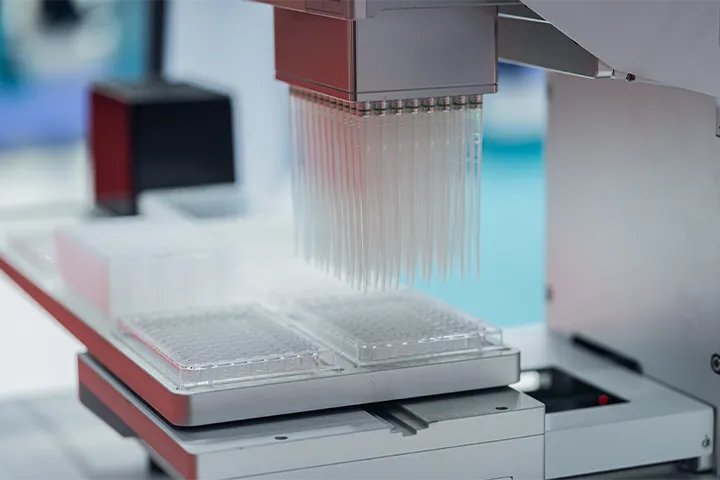
We believe autonomous labs will become the foundational infrastructure of the next era of science and biomanufacturing in Singapore. An autonomous lab connects experiment design, robotic execution, analytics and AI into one continuous design–build–test–learn loop. It runs around the clock, 24/7, and every result feeds the next decision.
We begin with adherent cells and their derivatives, applying our patented Tide Motion® technology to reinvent how cells are developed, expanded and manufactured at scale. We then extend the platform into immune cells, plant cells and the broader frontier of advanced cellular, biological and specialised modalities.
Our aim is a unified autonomous manufacturing infrastructure for Singapore biotechnology: one that lets Singapore science translate faster and at lower cost into globally investable biomedical companies, and that ultimately delivers returns to the Singapore government, founders, investors and all stakeholders.
We combine proprietary deeptech, recurring biosciences, bioservices and biomanufacturing revenue, AI-enabled
autonomous laboratories and Singapore's innovation ecosystem to build the infrastructure for the next generation
of biotechnology.
Why Autonomous, Why Now
Global context: The Industry Is Moving
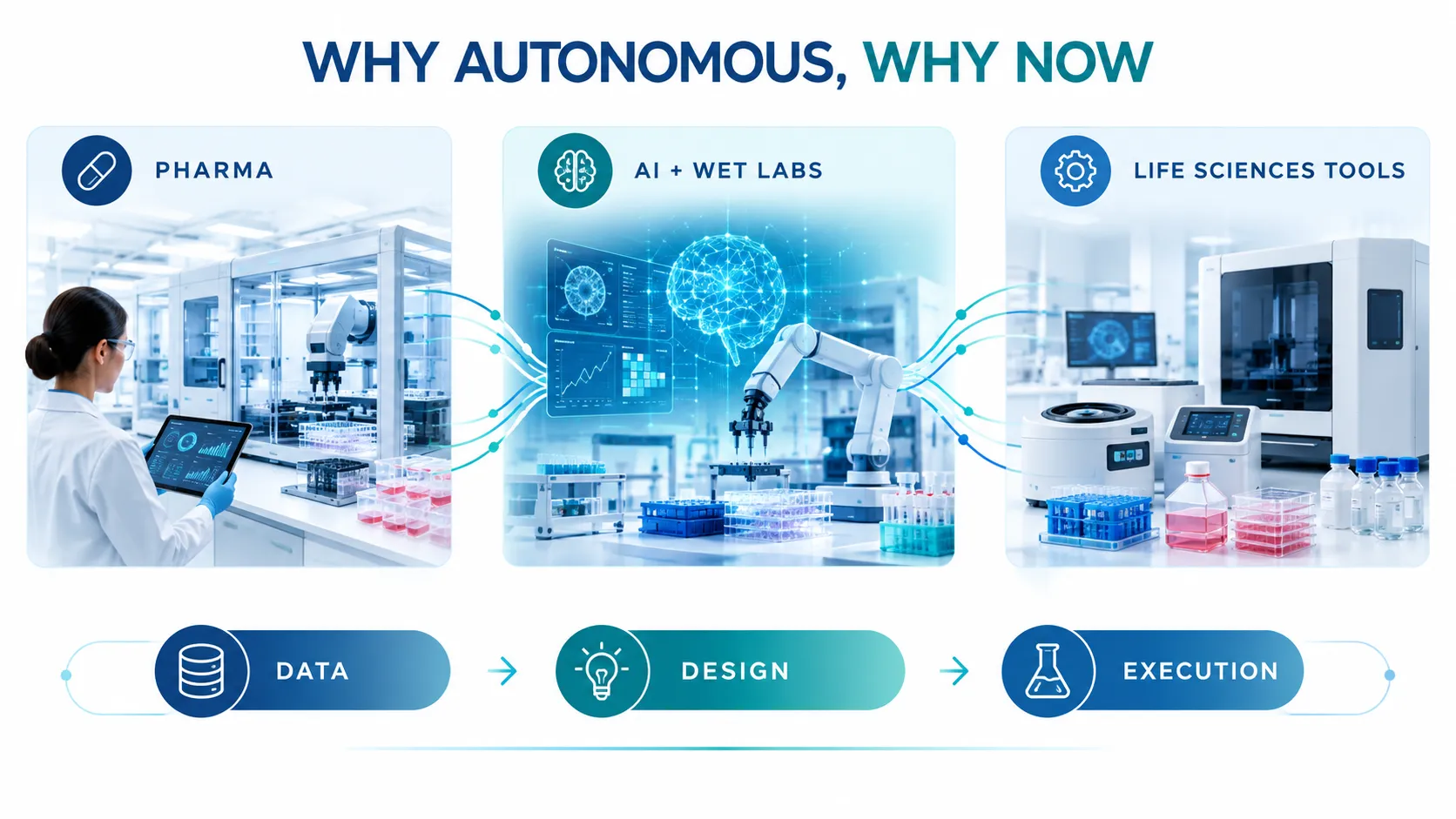
Big Pharma is entering autonomous labs.
In September 2026, Ginkgo Bioworks was selected to build an autonomous lab, powered by its Reconfigurable
Automation Cart architecture, at Novo Nordisk's new R&D site in Waltham, Massachusetts.1 The same month, Roche told investors at its Pharma Day that
it has started building autonomous, AI-driven labs as part of a commitment to "AI independence" in
R&D.2
AI companies are entering wet labs.
Frontier AI developers, including Anthropic, have been reported to be setting up their own biology laboratories. This is a sign that the value of AI in life sciences increasingly depends on generating proprietary experimental data.3
On 20 Oct 2026, OpenAI has acquired Orchestra Bio, a platform where AI agents help biopharma teams coordinate drug development programmes across studies, partners and timelines. It will be combined with OpenAI's Rosalind life sciences tools. The move shows that AI is expanding from discovery into the operational layer of drug development, which is the part that determines how quickly a promising molecule becomes a medicine.
Life sciences tool leaders are accelerating through
collaborations.
On 7 October 2026, Danaher announced its first AI-powered autonomous lab, based at Abcam. The lab designs
antibodies and other affinity reagents with AI, builds and tests each candidate, and feeds every result
back into the model. Danaher is targeting up to 8x faster discovery and a tenfold increase in annual
reagent output, with operation at scale expected in early 2027.4 A week later, on 14
October 2026, Danaher announced a collaboration with NVIDIA to bring AI into scientific instruments and
lab workflows.5
Autonomous Labs in Life Sciences
On 23rd Oct 2026, Kevin Weil, formerly of OpenAI, has launched Warp Sciences with US$215 million in funding at a US$865 million valuation. Investors include Lightspeed Venture Partners and angels such as Coinbase CEO Brian Armstrong. Warp is building a fully automated laboratory that combines AI models and robotics for molecule variant generation, a labour-intensive preclinical step that Bloomberg reports is largely concentrated in Chinese firms. Its team of about 20 has already assembled robotic arms and AI chips. Its chemists will wear cameras and sensor-equipped gloves during experiments, capturing the data used to train custom AI models. Warp positions itself as a preclinical contract research organisation, building infrastructure for drug developers rather than developing drugs itself.
Why it matters for autonomous deep tech
Both moves point the same way: capital and talent are flowing into AI-driven, automated science, and the labs that generate proprietary experimental data may become as valuable as the models trained on it. This is the infrastructure layer our deep tech autonomous programme supports ventures to build, and it is the kind of capacity Singapore is well placed to develop.
Singapore Context: National Momentum Behind AI And Automation
Singapore is investing heavily in exactly this convergence. In June 2026, the National Research Foundation launched the first eight projects under its S$120 million AI-for-Science (AI4S) Initiative, which pairs AI researchers with scientific domain experts to accelerate discovery. In parallel, the Economic Development Board is pushing manufacturers to adopt AI, robotics and advanced engineering to stay competitive on cost, labour and productivity.6
Esco Aster is enabling Singapore to take part in this shift with our own homegrown, proprietary,
AI/ML-enabled autonomous labs. They are built on a biomanufacturing platform that has already been
deployed in commercial human and animal vaccines, clinical-grade stem cells and exosomes.

The Esco Aster Autonomous Deeptech Platform: Automation for Science
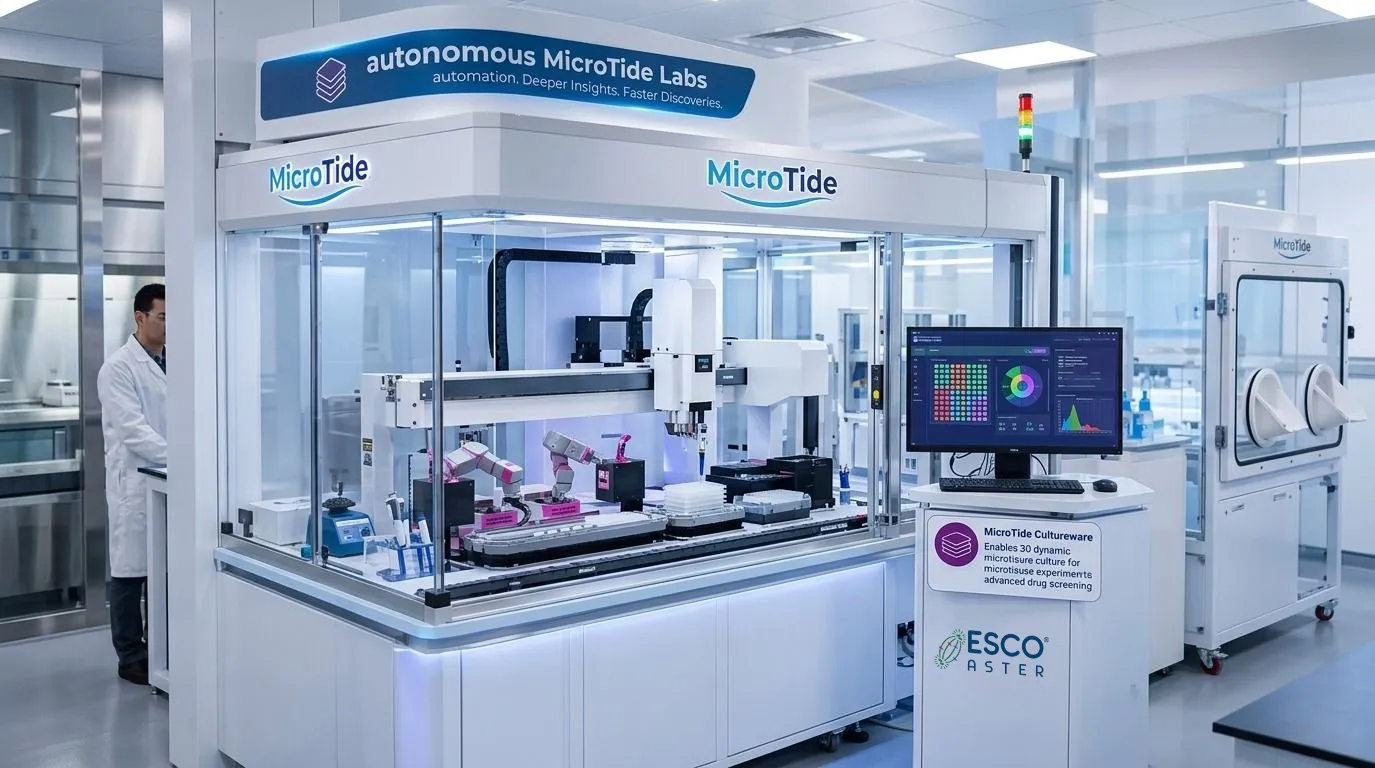
Most autonomous labs today stop at discovery: they design and screen molecules. Esco Aster's difference is that
our autonomous lab and our cGMP manufacturing run on the same linearly scalable Tide Motion® platform, so what is learned at bench scale transfers directly into
clinical and commercial production.
Esco Aster Autonomous Labs: discovery and process development
- High-throughput, parallel experimentation on MicroTide® and benchtop Tide Motion® bioreactors to generate rapid, high-fidelity data.
- Closed-loop optimisation of media, feeds, seeding density, Tide Motion® cycle parameters and harvest timing, with AI/ML models proposing the next experiment from every result.
- Automated cell line and clone selection, linked to our Cell Line Creation and Master Cell Banking services.
- Media formulation, linked to our Cell Line Creation service, to create optimised media and media enhancers. High-throughput screening with spent media analysis enables rapid media selection.
- Drug product formulation, linked to our development services, to ensure the final drug product is optimised, whether for freeze-drying, cryopreservation or with the right stabilisers.
- Integrated analytics with imaging and process analytical technologies (PAT), capturing cell growth, metabolism and product quality in real time.
- AI-ready data by design: structured, contextualised and traceable records that support CMC filings and investor due diligence.
Autonomous Biomanufacturing: from clinic to commercial
- One platform, linear scale-up: the same Tide Motion® principle from 0.1 L packed-bed volume at seed stage to 5,000 L packed-bed volume at production scale, bioequivalent to about 50,000 L in suspension.
- Closed, automated processing in isolators, including automated cell harvesting, reducing operator variability and contamination risk.
- Real-time in-process quality control and PAT, moving release decisions closer to the process.
- 21 CFR Part 11-compliant control software and electronic records, engineered by our MSAT as a Service team.
- Point-of-care extension: automated drug preparation for compounding pharmacies and clinical sites.
Our Roadmap by Modality
| Phase | Modality | What autonomy unlocks |
|---|---|---|
| 1 – Now | Adherent cells and derivatives: MSCs, exosomes/EVs, viral vaccines, viral vectors | Consistent, reproducible yields for fragile adherent cells; faster CMC for EV and vaccine programmes |
| 2 – Next | Immune cells: CAR-T and other cell therapies, including canine CAR-T | Reduced manual handling in autologous and allogeneic workflows; lower cost per dose |
| 3 – Expand | Plant cells, cellular agriculture and complementary proteins (Esco AsterMavors®) | Cost-competitive, scalable production for food and nutrition |
| 4 – Frontier | Advanced cellular, biological and specialised modalities | A shared autonomous infrastructure for new modalities as they emerge |
Built Into the Esco Aster Idea-to-Exit Offering
Autonomy is not a standalone product at Esco Aster. It strengthens every stage of our integrated CRDMO and
venture accelerator offering:
| Esco Aster Offering | How autonomous labs and biomanufacturing add value |
|---|---|
| Consultancy, CMC/QTPP strategy, COGS & TEA | Data-driven cost-of-goods models and techno-economic analysis based on real autonomous run data |
| Cell Line Creation & Master Cell Banking | Automated, high-throughput clone screening and characterisation |
| cGMP Process Development & Media Development | Closed-loop optimisation that compresses development timelines |
| MSAT as a Service | Engineering of the automation, mechatronics, single-use consumables and software that make processes autonomous |
| Clinical Trial Material & cGMP Manufacturing | Closed, automated Tide Motion® production with real-time quality control |
| Testing / Central Lab | Automated in-process and release testing, stability and CCIT workflows |
| Strategic Capital & Accelerator Programs (MetaMorphosis, BioGarage) | De-risked, data-rich programs that are easier to fund and more investable |
| Enterprise Solutions | Design and build of autonomous labs at your site: greenfield, brownfield, modular or containerised |
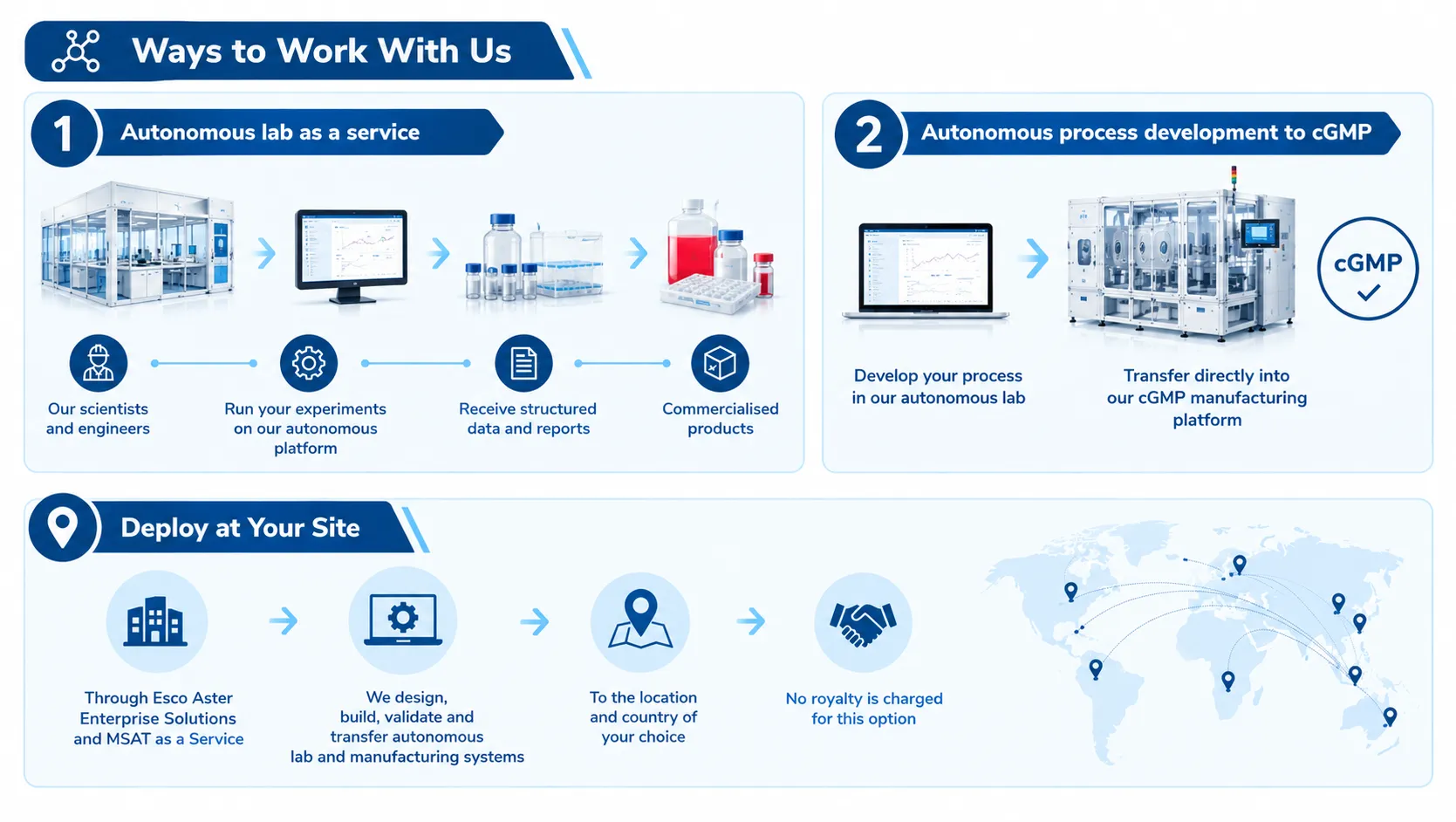
- Autonomous lab as a service: run your experiments on our autonomous platform in Singapore, with our scientists and engineers, and receive structured data and reports. Esco Aster charges a royalty on commercialised products (cell lines, media, final products) that are developed using our autonomous labs.
- Autonomous process development to cGMP: develop your process in the autonomous lab and transfer it directly into our cGMP manufacturing on the same platform.
- Deploy at your site: through Esco Aster Enterprise Solutions and MSAT as a Service, we design, build, validate and transfer autonomous lab and manufacturing systems to the location and country of your choice. No royalty is charged for this option.
Building Singapore's Autonomous Bioeconomy
Autonomous labs lower the cost and time of turning Singapore science into products. By anchoring them in a CRDMO with its own patented manufacturing platform, recurring service revenue and an investment-ready venture model, Esco Aster offers researchers, startups, pharma partners and public agencies a direct path from autonomous experimentation to clinical supply and commercial scale, under one roof.
Partner with us. Whether you are a research institute, a startup, a pharma company or a government agency, contact Esco Aster to explore autonomous labs and autonomous biomanufacturing for your program.
References
- Ginkgo Bioworks. Ginkgo Bioworks to Build an Autonomous Lab at Novo's New U.S. R&D Site in Waltham. 15 September 2026.
- Reuters (via KFGO). Roche outlines plans to move towards autonomous AI labs. 28 September 2026.
- Reuters (via The Star). Exclusive: Anthropic quietly sets up biology lab as it ramps AI drug program. 18 September 2026.
- Danaher (via HPCwire). Danaher Accelerates Life Sciences Research with New AI-powered Autonomous Lab. 7 October 2026. Design targets and timing also reported by BioSpectrum Asia, 9 October 2026.
- Danaher (via PR Newswire). Danaher Collaborates with NVIDIA to Advance Autonomous Science. 14 October 2026.
- National Research Foundation, Singapore. AI-for-Science (AI4S) Initiative: inaugural projects. 16 June 2026.
- OpenAI, "OpenAI acquires Orchestra Bio", 20 Oct 2026: https://openai.com/index/openai-to-acquire-orchestra-bio/
- Bloomberg, "Ex-OpenAI science head Kevin Weil launches startup with $215 million", 22 Oct 2026: https://www.bloomberg.com/news/articles/2026-10-22/ex-openai-science-head-kevin-weil-launches-startup-with-215-million
- Warp Sciences, "What we believe": https://warp.xyz/what-we-believe/